
In World War I, Wilhelm Buethner was in the German Army. His assignment was to care for the horses that pulled the cannons to fight against the Russians. During a gas attack, Wilhelm suffered the loss of his sense of smell. After the war, he was awarded a small disability annuity for his injury. The monthly payments continued until he died in Florida in 1977.
Wilhlem, born in 1892, was the son of a tavern owner in Berlin, Germany. He learned his trade as a tool and die maker, and married Elsbeth Schulz. In 1927, they came by ship to America with their daughter Ursula. Wilhelm Buethner became William Burtner. His German friends called him “Willie” and everyone else called him “Bill”.
When he first came to the United States, Bill worked as a mason’s helper while he learned the english language, then he went to work at his trade. Long Island, New York was a hotbed in the early days of aviation and he saw it all. He knew many of the pioneers in that field. He worked for Seversky and for Sikorsky, the early developers of the helicopter. He also worked for Republic Aircraft and Chance-Vought Aircraft. In 1933, Bill went to work for EDO Aircraft in College Point, New York.
Bill was involved in the design and fabrication of floats for various aircraft, including some for Charles Lindberg and Admiral Byrd. I remember he had two model airplanes proudly displayed on the mantel of his College Point home. One was a solid aluminum model of Lindberg’s airplane, “The Spirit of St. Louis”, and the other was a Chance-Vought F4U, the iconic gull-winged Navy warplane.
World War II created a huge demand for military aircraft floats. As Assistant Division Superintendent, Bill headed up a fabrication shop. According to one College Point resident, he hired “every German toolmaker and machinist he could find, including my father”, and as a result “put food on the table for my family”. Bill put all his skills to work, revamping tool designs and manufacturing processes to make the production faster and more safe. In 1943 he won a National Safety Ace Award for one of his designs.

After the war, Bill “retired” to his one hundred acre retreat in the Catskill Mountain of upstate New York, living in a house he had built himself. He and Elsbeth took me with them in 1947. He had a small machine shop there and planned to do some contract work from time to time. That only lasted a year. They moved back to the city, gave me back to my mother, and Bill started work at Sperry Gyroscope Corporation. The company manufactured guidance system for ships, aircraft and missiles.
Bill always took great pride in his work, immersing himself in the tiny details of his craft. He had a metal lathe in his basement workshop, and loved the shaping of hard steel or soft aluminum into useful objects. Once, he showed me a rectangular aluminum box, about one and a half inches wide and high, and about two inches long. It had a hinged lid. At Sperry, Bill had designed the tool that made this box, which was an electrical junction box for the instrument panel of the Boeing 707 aircraft. He explained to me the intricacies of bending allowances and tiny tolerances that went into this simple object.
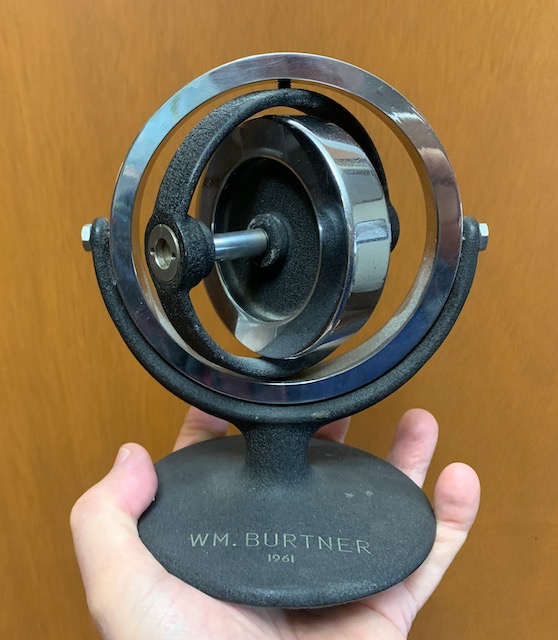
Bill “retired” again in 1961, but when I returned home for military service in 1964, I found him working every day in a small local machine shop, still making tools to shape metal to his will.
Bill’s German-born love for precision and order carried over into his off-duty life. He owned just three cars during my lifetime, all Plymouths: a 1941, a 1955, and a 1968. They were all “base” models with manual transmissions, and, apart from a radio, no amenities. Every Saturday, Bill would check under the hood. He bought motor oil and distilled water from Sears. He’d check the oil level and battery level, and top off these fluids precisely every week. He had an air pressure gauge (not the stick kind, but one with a real dial), and checked each tire, pumping them up with manual air pump.
Reflecting on my grandfather’s life, it amazes me the advances he was part of. Young Wilhelm taking care of horses in the muddy battlefields of World War I; Bill, the tool and die maker, acquainted with pioneers in aviation, making parts for helicopters and airplanes; Bill, the superintendent, helping to win World War II by making water landings possible for military aircraft; and Bill the tool-maker seeing parts he helped create flying high in the sky and even into space.
Bill Burtner loved this country, and he made the most of the opportunity it gave him. And he returned the favor by giving his best to America. He never lost that German love for precision and “ordnung”, nor did that distinctly German accent ever leave him. He was my Grandpa and I loved him.
 Robert Frohlich