We had traveled over six hundred miles to Matewan, West Virginia, arriving on a Sunday afternoon in 1985. A few hours later, I was ready to turn around and go back home, because it was hopeless.
The Appalachia Service Project (ASP) operates work centers throughout the region. Ours was located in a high school, where we slept on the floor. This was the first year our church participated in the project. We brought energetic teens, a few adult leaders, a truckload of supplies, and some tools. ASP provided leadership, more tools and supplies, and homes needing repair.
Sunday evening, after supper, the center staff took us to the site we’d be working on. It was unbelievable. It was an old mobile home, recently moved to a flat spot on the side of a hill. The roof leaked. The floors inside the home were rotting, with holes big enough that the smaller children could fall through. Living in that home were nine children. And Mom and Dad. A large deck was already being built, started by a crew from the previous week. Half the deck would be made into a bedroom for the parents, and the whole thing would be roofed in.
In the words of my handyman friend Art, this was a “three-sticker”, that is, three sticks of dynamite would be an appropriate means to address the impossible structure before us. Had Art been there, that would have been his counsel. I was sick to my stomach, and I just wanted to go home again.
There would be two crews working on the site that week. One would be framing and roofing the deck/bedroom, and my crew would fix the floor. To fix the floor we set two-by-fours on edge, sixteen inches on center, and put insulation between. Then we put down plywood for a new floor. My thought was that no one in the family was very tall and so they’d not miss the headroom.
One of the things ASP does is to use local materials as much as possible. Sometimes they’d get dimensional lumber from local saw mills. The bad news was that rather than the soft pine generally used for construction, they would get oak. You can’t nail oak, at least not easily, But oak was what we got for the rafters, making it necessary to pre-drill the nail holes when we placed the roof decking.
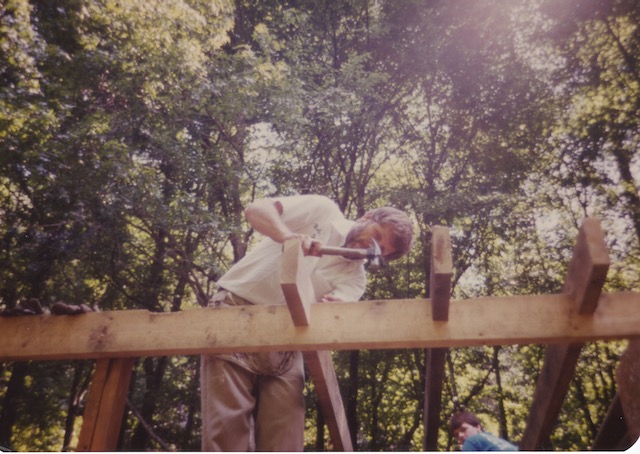
At the end of the week, the floor was done, the roof was sealed with tar, and the deck/bedroom was framed and roofed. The crew next week would install vinyl flooring and close in the room, before cutting in a passage door from the home to the new bedroom. By the end of summer, it would be done.
I’ve taken many photos at worksites over the years, most of which I can’t share because they are pictures of people whose privacy must be respected. In fact, I learned to have great respect for the Appalachian people, for their resilience, resourcefulness, and gracious acceptance of our meager efforts. This photo is probably my favorite. There are three girls in the foreground, two teen volunteers, and between them is one of the nine kids living in the improved home. It portrays the simple bond between helper and the one being helped. It looks like love.

For information about the Appalachia’s Service Project go to: https://asphome.org
 Robert Frohlich